
The Bedeken: The Jewish Veiling Ceremony, and Which Veil Works

In short
The bedeken is the veiling of the bride at a Jewish wedding. Before the chuppah, the groom looks at the bride's face and lowers her veil over it. You need a veil with a blusher that can be lowered and lifted easily, such as a two tier or drop veil. Customs differ, so ask your rabbi.
The bedeken (also spelt badeken) is the veiling of the bride at a Jewish wedding. Shortly before the chuppah, the groom comes to the bride, looks at her face and lowers her veil over it. In many communities she then wears it over her face until the end of the ceremony. For a bedeken you need a veil with a blusher, the front layer that can be brought forward over your face and lifted again. A two tier veil or a drop veil does this.
I make veils, and I am not a rabbi. Customs differ between communities and families, so please talk to your rabbi about how your bedeken will be done. The sources I relied on are listed at the end.
What happens at the bedeken
The word comes from Yiddish and means "covering". Before the ceremony, the bride is usually seated, receiving her guests. The groom is brought to her by his family and friends, often with singing. He looks at her, then lowers the veil over her face. In many weddings the parents, grandparents or the rabbi bless her at this moment, and the groom's party then leaves so the couple can get ready for the chuppah.
In Reform weddings the bedeken often takes place with the signing of the ketubah, shortly before the ceremony begins, and it can be done by a partner of any gender.
Where the custom comes from
Two stories from the book of Genesis are usually given.
The first is Rebecca. When she first sees Isaac, she takes her veil and covers herself (Genesis 24:65). The blessing her family gave her before she left, "our sister, may you become thousands of ten thousands" (Genesis 24:60), is often said to the bride at the bedeken.
The second is Jacob. He was meant to marry Rachel, but was given her sister Leah under a heavy veil, and did not know until the morning (Genesis 29). Many say the groom looks at the bride's face before he veils her so that this can never happen again.
Teachers also give a deeper meaning: the groom covers the bride's face to say that he loves who she is, more than how she looks.
Which veil works for a bedeken
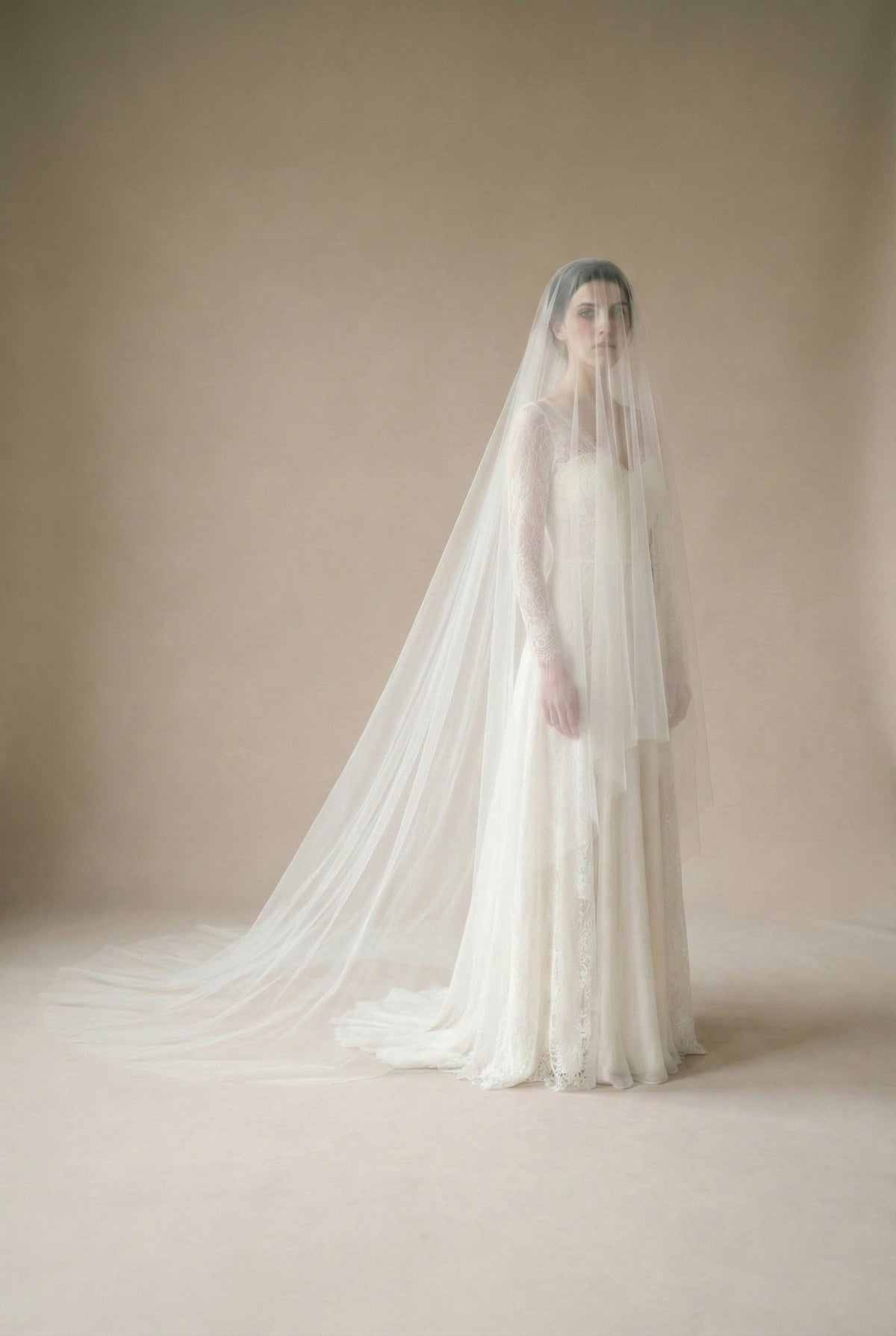
The veil has to do two things: be lowered over your face by someone else, easily and in one movement, and later be lifted back. That needs a blusher. A single tier veil has no front layer, so it cannot be lowered over the face.
A two tier veil
A two tier veil is gathered onto a comb with a shorter layer at the front. You wear the blusher back over your head while you receive your guests, and the groom brings it forward over your face. Our standard blusher is 72cm from the comb, which falls to around your waist.

A drop veil
A drop veil is one oval of tulle with no gathering, folded over a comb so that one part falls at the front and the rest behind. It has a softer, flatter line than a two tier veil, and the blusher lies smoothly over your face. Our Eleanor drop veil has an extra long blusher, 100cm from the comb, which falls past your waist and over your bouquet.
Can you see through it?
Yes. Our blushers are made from sheer tulle, so your face shows softly through, and you can see out. Some Chassidic families follow a custom that the bride's veil should be thick enough to hide her face completely. A sheer tulle veil does not do that, so if your community follows that custom, ask your rabbi before you choose.
Getting it right on the day
- Put the comb high. Wear the comb at the crown, so the blusher flips forward cleanly over your head. A comb set low at the back pulls the blusher flat.
- Wear the blusher back to begin with. Your hairdresser can settle it back over your hair once the comb is in, so it is ready for the groom.
- Practise once together. Show the groom how to take the blusher at both front corners and bring it forward over your face in one smooth movement. Thirty seconds of practice the day before saves a fumble in front of everyone.
- Plan who lifts it, and when. Ask your rabbi when the veil comes up in your ceremony. To lift it, take the front edge with both hands and lay it back over your head.

Sources
- Genesis 24:60 and 24:65 (Rebecca), and Genesis 29 (Jacob and Leah).
- Chabad.org, The Veiling: the groom covers the bride's face before the chuppah; the custom that the veil hides the face; the meaning of the veiling.
- ReformJudaism.org, Is a bride at a Jewish wedding required to wear a veil?: the bedeken in Reform practice and its two origin stories.
- Rabbi Raymond Apple, OzTorah, Lifting a bride's veil.
You can see every veil with a blusher in our wedding veils, and our post on who unveils the bride covers the lifting of the veil at other weddings.
Sarah Jane x
Your questions
How does the blusher on a two tier veil work during the ceremony?
You wear the blusher back over your head to begin with. At the right moment it is brought forward over your face, and later lifted back, where it stays for the rest of the day.
Can the blusher be made longer?
Our blusher lengths are fixed by design. If you want more coverage, choose a veil made with an extra long blusher, such as Eleanor, whose blusher is 100cm from the comb.
How do you wear a drop veil with a blusher?
Set the comb high at the crown, with the shorter layer at the front. When it is lowered, it lies smoothly over your face with no gathering.
 The collection Wedding Veils See the collection


