
Catholic Wedding Veils: What the Church Asks For, and How to Choose

In short
The Catholic Church does not require a bride to wear a veil: the old head-covering rule was dropped in 1983. Many Catholic brides still wear one, most often a lace mantilla or a long cathedral veil. Some churches ask for covered shoulders, so check with your parish first.
The Catholic Church does not require a bride to wear a veil. The old rule that women cover their heads in church was dropped when the Code of Canon Law was replaced in 1983, and the marriage rite asks for no veil. Many Catholic brides still wear one because it belongs to the tradition, and a lace mantilla or a long cathedral veil is the most common choice. Some churches ask for covered shoulders, so check with your parish before you choose your dress and veil.
I make veils, and I am not a priest or a canon lawyer. Parishes differ, so ask yours what they expect. The sources I relied on are listed at the end.
Do you have to wear a veil at a Catholic wedding?
No. The 1917 Code of Canon Law asked women to cover their heads in church (canon 1262). When the new Code came into force in 1983, it replaced the old one as a whole and did not repeat that rule. The custom had already been fading since the early 1970s.
So the choice is yours. Some brides from traditional parishes, or marrying at a Latin Mass, wear a veil because their community still keeps the custom. Others wear one because they love how it looks in church. Both are good reasons. Our page on whether brides have to wear a veil looks at the wider question.
Shoulders and modesty
Some churches ask brides and guests to cover their shoulders, and this is common in the great churches of Rome and in other busy places of pilgrimage. If your dress is strapless or has thin straps, ask your parish early. A long veil worn over the shoulders covers them during the ceremony, and a lace mantilla does this well. A cape or a light cover-up is another option; see our bridal cover-ups and capes.
Why so many Catholic brides choose a mantilla
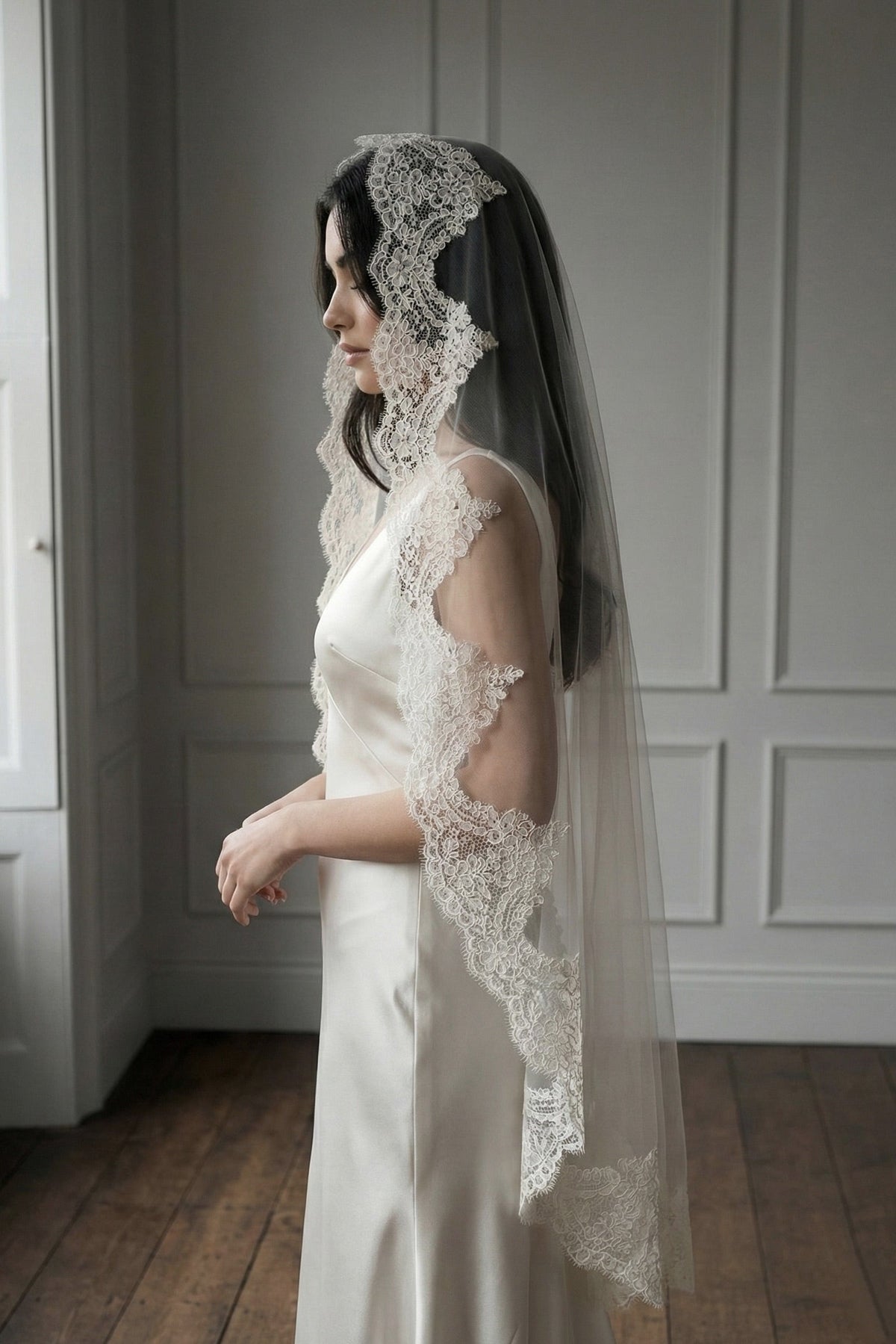
The mantilla is the Spanish lace veil that women have worn to Mass for centuries, and it is still worn in Spain, Latin America and by many Catholic women elsewhere. For a bride it links the wedding to that long tradition. It is also flattering. The lace sits at the crown and frames the face, and it looks lovely against old stone and candlelight.
Our guide on how to wear a mantilla veil shows where to place it and which hairstyles suit it, and you can see every lace on our mantilla veils page.


Choosing a length for a church aisle
Church aisles are often long, so longer veils suit them well. A cathedral length veil (300cm, 118 inches) makes a train of its own as you walk. Church length (250cm, 98 inches) trails a little and is easier to manage in a smaller church. A bride who wrote to us about her Catholic wedding wanted her veil to end just past a long train; for that, aim for 30 to 50cm past the end of the train.
Our post on church vs cathedral length veils compares the two side by side. You can browse cathedral length veils made in our Bath workshop.
The blusher and the unveiling
A veil with a blusher, the short front layer, lets you walk up the aisle with your face covered. Who lifts it is up to you: traditionally your father lifts it at the altar, or you keep it down until after the vows and your husband lifts it. Our post on who unveils the bride covers both. Talk it through with your priest, so everyone knows when it will happen.
The veil and cord in Filipino and Hispanic weddings
In many Filipino weddings, and some Hispanic ones, sponsors place a second, larger veil over the bride's head and the groom's shoulders during the Mass, and often a cord or lazo, in a figure of eight, around them both. It is a sign that the couple are now joined as one. In the United States, the English edition of the marriage rite allows the blessing and placing of the lazo or the veil just before the Nuptial Blessing.
That veil is separate from your bridal veil. It is draped over you and lifted off again after the blessing, so your own veil stays where it is. If your families keep this custom, ask your priest how it will fit into your Mass.
Real church weddings
If you would like to see veils in church, our church weddings gallery has more than 600 photographs of real Britten brides.
Sources
- Catholic Answers, How women came to be bare-headed in church: canon 1262 of the 1917 Code and its absence from the 1983 Code.
- Catholic Exchange, on head coverings and the 1983 Code: no obligation, and no ban.
- United States Conference of Catholic Bishops, Committee on Divine Worship newsletter, July 2015: the Order of Celebrating Matrimony allows the blessing and placing of the lazo or the veil before the Nuptial Blessing.
- Mama Lisa's World, Filipino wedding traditions: candles, coins, veil and cord.
Every veil in our wedding veils is made to order in Bath, including all our mantillas.
Sarah Jane x
Your questions
How long should my veil be for a Catholic church wedding with a long train?
Aim for the veil to end about 30 to 50cm past the end of your train. Measure from where the comb will sit, wearing your wedding shoes.
How do I choose the right mantilla length for my dress?
Fingertip shows the lace around your shoulders. Floor, church and cathedral lengths carry it to the floor and behind you, which suits a long church aisle.
What makes a mantilla different from other wedding veils?
A mantilla has lace all the way around and no gathering at the comb, so it lies flat and frames the face instead of standing up from the head.
 The collection Velos de novia See the collection


